


Hidden Places That Make Your Home Feel Cluttered
Your home may not need more organizing. It may simply need a closer look at the spaces quietly collecting everyday life.
There are times when a home is obviously cluttered. The kitchen counter is covered, shoes are scattered by the door, laundry is
waiting to be folded, and there are simply too many things sitting out.
And then there are the other times.
You’ve picked up. The counters are mostly clear. The pillows are back where they belong. Nothing looks particularly messy.
But your home still doesn’t feel quite as calm as you’d like it to.
If you’ve ever wondered why your house can be clean and still somehow feel cluttered, the answer may not be sitting right in front
of you.
It may be inside the drawer you struggle to close.
Behind the cabinet door where you have to move three things to reach the one you need.
On the closet shelf where you’ve been putting things “for now” for the past two years.
Or in the bag by the door filled with things you’ve been meaning to return.
Clutter isn’t always obvious. Some of the most frustrating clutter in our homes lives in the places we don’t immediately see.
And while those spaces may be hidden, the friction they create isn’t.
The good news is that you don’t need to declutter your entire house to make your home feel better. Sometimes a few small changes
in the right places can make everyday life noticeably easier.
Let’s start with the places we tend to overlook.
Why Hidden Clutter Matters More Than You Might Think
We tend to think about clutter visually.
If a room looks neat, we assume the problem has been solved.
But we don’t only look at our homes. We live in them.
We open drawers. Reach into cabinets. Put groceries away. Walk through the entryway. Search for things. Bring packages inside
Sort mail. Get dressed. Make dinner. Put laundry away.
And every time a space makes one of those ordinary tasks harder than it needs to be, it creates a little bit of friction.
Research into how people experience their homes offers an interesting perspective. In a study of 60 adults from dual-income
households, UCLA researchers Darby Saxbe and Rena Repetti analyzed the language participants used during self-guided tours of
their homes. Words describing clutter and unfinished areas were combined into what researchers called a “stressful home”
measure. Among the women studied, higher stressful-home scores were associated with flatter daily cortisol patterns and
worsening mood over the course of the day.
That doesn’t mean an overflowing junk drawer is automatically responsible for your stress.
But it does reinforce a useful idea:
The way we experience our surroundings matters.
A broader UCLA’s Center on Everyday Lives of Families study documented how possessions accumulated throughout the homes
they studied, sometimes overflowing into spaces originally intended for other uses. The larger project followed 32 middle-class,
dual-income Los Angeles families and produced nearly 20,000 photographs documenting everyday household life.
The lesson for our own homes is much simpler.
The cabinet may technically hold everything—but you have to rearrange it every time you put something away.
The closet may technically have space—but only if you don’t open the door too quickly.
The kitchen island may get cleared—but by tomorrow afternoon, everything has returned.
Hidden clutter matters because we interact with it again and again.
The goal isn’t to create a home where every drawer looks ready for a photograph.
It’s to create a home that asks a little less of you.
A home where putting something away is easier. Where you can find what you need. Where surfaces don’t constantly need to be rescued.
That kind of organization has very little to do with perfection.
It has everything to do with making everyday life work better.
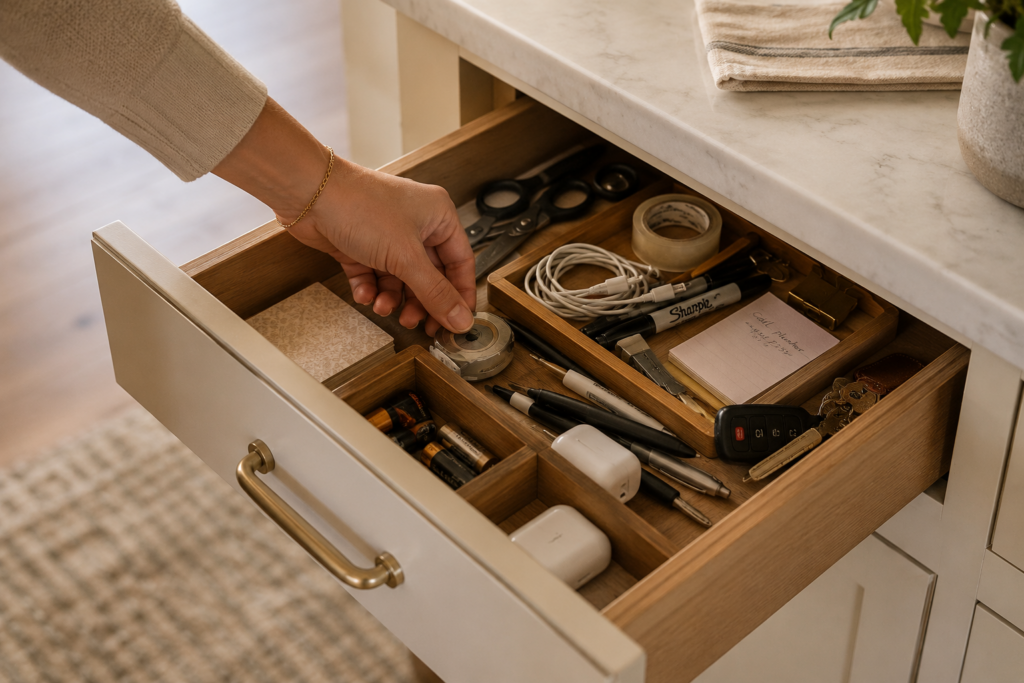
7 Hidden Places That May Be Making Your Home Feel Cluttered
1. The Surfaces That Quietly Became Landing Zones
There is usually at least one.
Maybe it’s the kitchen island.
The console table by the door.
Your bedroom dresser.
The dining room table.
A corner of the kitchen counter.
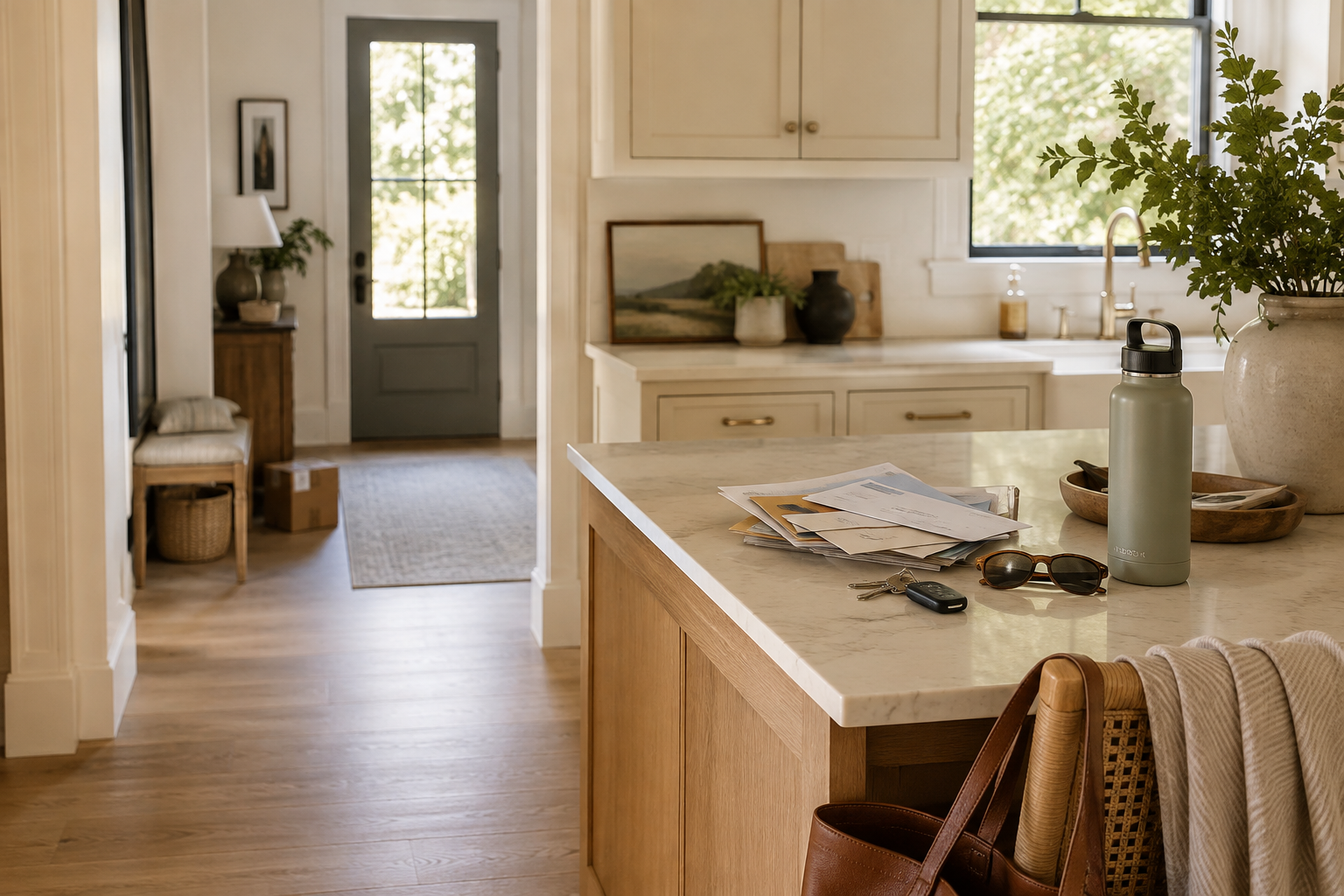
At some point, the surface stopped being simply a surface and became a landing zone for everyday life.
Mail arrives. Keys get dropped. Someone takes off a pair of sunglasses. A package comes in. There’s something that needs to go upstairs. A receipt needs to be dealt with.
None of those things is particularly problematic on its own.
The problem is that the same categories of things keep returning.
We often respond by clearing the surface again and again. Everything gets put away, the counter looks wonderful, and we feel accomplished.
Then two days later, the pile is back.
Instead of asking, “How do I keep this counter clear?” try asking:
“What keeps landing here—and why?”
That question gives you much better information.
If mail constantly collects on the kitchen counter, perhaps the problem isn’t the counter. The mail doesn’t have a simple next step.
If shoes collect beside the console, the household may need a more realistic shoe system.
If everything that needs to go upstairs accumulates on the bottom stair, those items are telling you that your home has a transition problem.
Pay attention to what repeatedly appears.
Don’t organize the pile. Solve why the pile keeps forming.
Sometimes the answer is a basket.
Sometimes it’s a hook.
Sometimes it’s a recycling bin closer to where the mail enters.
And sometimes the answer is simply deciding that something shouldn’t be coming into the house in the first place.
The best organizing systems often begin by noticing what your family is already doing rather than trying to force everyone into an entirely different routine.
2. The Drawers You Use Every Single Day
There are drawers in our homes that could remain messy for months without affecting anything.
And then there are the drawers we open five times before lunch.
Those are the ones worth paying attention to.
The kitchen utensil drawer. Your bathroom vanity. The junk drawer. The nightstand. The place where pens, scissors, batteries, tape and every miscellaneous household item somehow end up together.
Because drawer clutter is hidden, it’s easy to ignore.
Close the drawer and the room immediately looks tidy.
But every time you open it, you’re interacting with that clutter again.
You move things around. You search. Something catches. The drawer doesn’t close. You can’t find the scissors even though you’re
quite certain you own six pairs.
This is one of the reasons organizing doesn’t always need to begin with the biggest space in your house.
Sometimes the best place to begin is the space creating the most frequent frustration.
For one manageable drawer, take everything out so you can see what you’re actually working with.
Group similar things together. Remove obvious trash. Look for duplicates. Ask whether everything stored there actually needs to be within arm’s reach.
Then give the remaining categories enough structure that putting something back becomes obvious.
You don’t necessarily need a complicated organizing product.
You need boundaries.
And most importantly, you need some breathing room.
A drawer packed to 100 percent capacity is difficult to maintain because there is nowhere for ordinary life to happen.
Leave a little space.
You’ll be surprised by how much easier the drawer becomes to use.

✨ Gretchen’s Tip
I’ve learned that the drawers worth organizing first aren’t necessarily the messiest ones. They’re the ones I use the most.
Fixing one drawer you open five times every day can improve your
routine more than organizing an entire closet you barely use.
Start where the frustration repeats.
3. Behind Closed Cabinet Doors
Closed doors are wonderful.
They give us the ability to put things away and immediately make a room look calmer.
But there’s an important distinction:
Hidden isn’t the same thing as organized.
A cabinet can make your kitchen look perfectly tidy while creating frustration every time you open it.
This happens when we focus entirely on whether something fits.
Technically, another mug fits.
Technically, you can squeeze another pan onto the shelf.
But fitting something into a space isn’t the same as having functional storage.
Try a different test.
Instead of asking:
“Can I fit this in here?”
Ask:
“Can I easily take this out—and easily put it back?”
If you need to remove four pans to reach the one you use every week, the cabinet isn’t really working.
If putting away a mixing bowl requires rearranging an entire shelf, eventually that bowl is probably going to live on the counter.
Good storage should support the way you use your home.
Start with the things you reach for most often and make those easiest to access.
Move rarely used items higher or farther back. Remove duplicates you don’t actually need.
And resist the urge to fill every inch simply because the space exists.
Empty space is functional space.
It gives you room to move things, see what you have and put items away without rearranging the entire cabinet.
If the kitchen is where most of your cabinet frustration lives, How to Organize Your Kitchen Once—and Keep It takes this function-first approach further with systems designed around the way you actually use your kitchen.
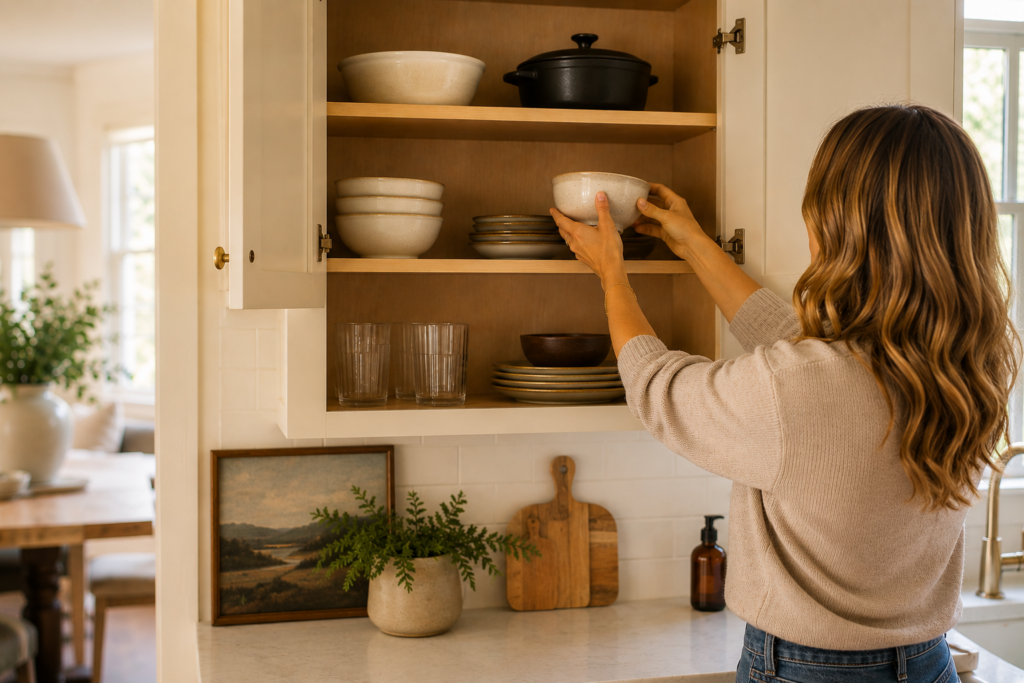
4. Entryways and the Spaces Between Spaces
Some of the most clutter-prone areas in a home aren’t really rooms at all.
They’re transition zones.
The entryway. The hallway. The stairs. The mudroom. The chair near the door. The corner where bags get dropped.
These spaces collect things because things are constantly moving through them.
Shoes are coming off. Packages are coming in. Backpacks are going out. Keys need somewhere to land. Mail is waiting to be sorted. Something needs to go upstairs. Something else needs to be returned.
These aren’t necessarily things that belong in the entryway.
They’re things in transition.
That’s an important distinction.
When clutter continually collects in one of these spaces, look at where those items are trying to go next.
Keys need a permanent landing spot.
Shoes need a realistic boundary.
Mail needs a simple decision point.
Packages need to be opened and the packaging removed.
Items going upstairs may need a small transition basket rather than becoming permanent residents of the staircase.
Returns need an exit strategy.
The goal isn’t to stop life from passing through these areas. That’s exactly what they’re designed for.
The goal is to keep the transition moving.
One of the easiest ways to think about these spaces is with a simple rule:
Nothing lives permanently in a transition zone.
Things can land there temporarily.
But they need a next destination.
That small distinction can dramatically change how an entryway—or even an entire first floor—feels.
5. Closet Floors and the Shelves You Can Barely Reach
Closets have a remarkable ability to make things disappear.
Especially the floor.
And that shelf at the very top.
You know the one.
It’s where things go when you aren’t quite sure what else to do with them.
Extra bags. Empty boxes. Seasonal items. Shoes you might wear again. Things you’re saving for someone. Items you don’t use but aren’t ready to get rid of.
The object gets placed there “for now.”
And “for now” quietly becomes permanent storage.
That’s what makes closet floors and upper shelves such easy clutter zones. They’re convenient places to postpone deciding where something actually belongs.
Before buying another container or stacking another bin, pull out one manageable section and look at what you’ve been storing.
Do you still use it?
Would you remember you owned it if you weren’t looking at it right now?
Are you keeping it because it’s useful—or simply because there’s room?
And if you’re keeping it, where should it actually live?
Storage space is not automatically space that needs to be filled.
A little unused space gives your home flexibility for the things life brings next.
6. The Overflow You Forgot You Owned
This category can be particularly sneaky because most of the things in it are useful.
Extra shampoo.
Paper towels.
Cleaning supplies.
Pantry staples.
Freezer food.
Toilet paper.
Beauty products.
Household refills.
There’s nothing wrong with keeping extras.
The problem begins when you stop knowing what you have.
Then the backup bottle gets pushed behind another bottle.
You buy more.
The pantry shelf gets crowded.
The bathroom cabinet holds four versions of the same thing.
Useful items slowly become clutter because the quantity exceeds what the space can comfortably manage.
The easiest solution isn’t a complicated household inventory spreadsheet.
For most homes, a physical boundary can do the work.
Choose where your backstock lives.
Maybe toiletries get one basket. Cleaning refills get one shelf. Pantry overflow gets one designated area. Paper products get one section of a closet.
Then allow the boundary to tell you when you have enough.
If the basket is full, you probably don’t need another backup yet.
If the shelf is full, use what you already have before buying more.
This also makes shopping easier because you can actually see your inventory.
Simple boundaries do something complicated systems often don’t:
They make the next decision easier.
7. The Things Waiting for a Decision
This may be the most overlooked form of clutter in the entire house.
The return sitting beside the door.
The donation bag in the closet.
The picture waiting to be hung.
The shirt missing a button.
The paperwork you need to review.
The box you’re saving because you might need it.
The item you borrowed and need to return.
The things you’ve been meaning to give someone.
The little project you started but haven’t finished.
None of these necessarily looks like traditional clutter.
Some may even be neatly stacked.
But every time you see them, they quietly remind you:
You still need to do something with me.
That’s why one of the most useful ways to think about clutter is this:
Clutter isn’t always too much stuff. Sometimes it’s too many unfinished decisions.
And unfinished decisions are difficult to organize because the item hasn’t reached its final destination.
You can’t really organize a return.
It needs to leave.
You can’t create a permanent organizing system for a donation bag.
It needs to be donated.
Paperwork that requires a decision needs the decision more than it needs a prettier basket.
A picture waiting to be hung needs to be hung—or you need to decide you no longer want it.
When you find these items, resist the urge to simply move them somewhere less visible.
Complete the decision.
Return it.
Donate it.
Repair it.
File it.
Schedule it.
Give it away.
Keep it and assign it a real home.
Or let it go.
Sometimes the fastest way to make a home feel lighter isn’t organizing anything at all.
It’s finishing what has been waiting for your attention.
✔️ Try this Today – Find One Place That’s Making Life Harder
You do not need to spend Saturday decluttering your entire house.
Choose one place.
One drawer.
One surface.
One cabinet.
One shelf.
One unfinished-decision pile.
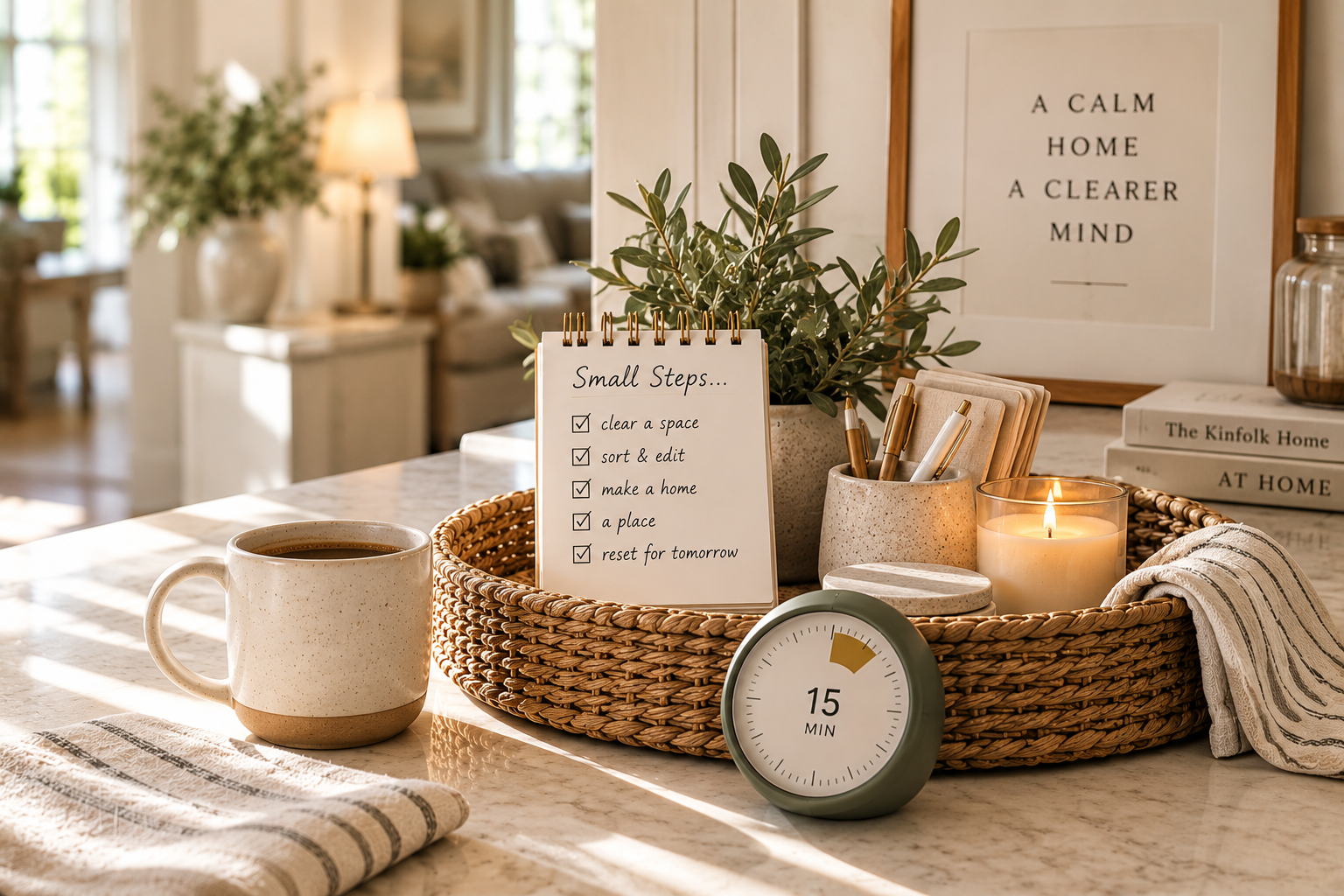
Set a timer for 15 minutes.
Then ask yourself three questions:
1. What keeps collecting here?
Don’t judge it. Just notice the pattern.
2. Why does it keep ending up here?
Is this the most convenient location? Does the item lack a home? Is a decision being postponed? Is the current system too difficult?
3. What would make putting it away easier?
Then change that one thing.
Maybe you add a small basket.
Maybe you remove half the contents of a drawer.
Maybe you relocate something closer to where it’s actually used.
Maybe you finally put the return in your car.
If you like working in short bursts like this, 15-Minute Decluttering Wins offers more small projects that create progress without turning organization into an all-day event.
Fifteen minutes isn’t enough time to create a perfect home.
It is enough time to remove one repeated frustration.
And that’s how sustainable organization usually begins.
Not with an enormous transformation.
With one space that works a little better than it did yesterday.
The Hidden Clutter Reset Infographic
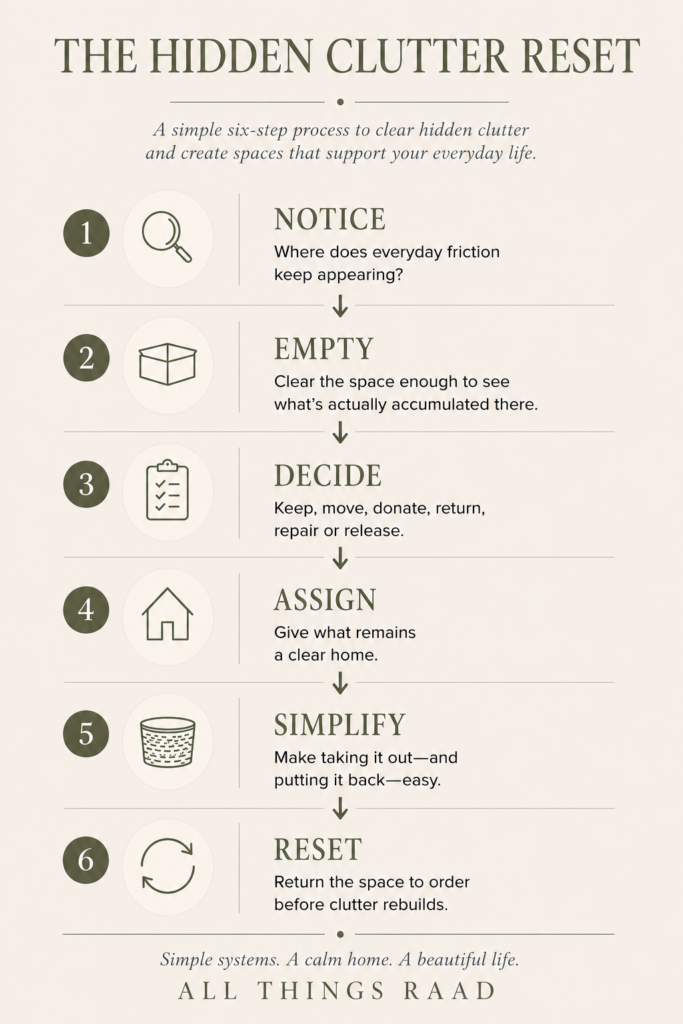
The Hidden Clutter Reset
When you find another clutter-prone space, you don’t need to reinvent the process.
Use the same simple reset.
NOTICE
Where does everyday friction keep appearing?
EMPTY
Clear the space enough to see what’s actually accumulated there.
DECIDE
Keep, move, donate, return, repair or release.
ASSIGN
Give what remains a clear home.
SIMPLIFY
Make taking it out—and putting it back—easy.
RESET
Return the space to order before clutter rebuilds.
Notice → Empty → Decide → Assign → Simplify → Reset
You can use this on a single drawer or an entire closet.
The size of the space changes.
The system doesn’t.
And once a space is working again, a few simple routines can help keep it that way. Daily Habits to Stay Organized offers practical ways to prevent everyday clutter from quietly rebuilding.
Simple systems. A calm home. A beautiful life.

☕ From Gretchen :
As I’ve been working through my own home reset, I’ve started noticing something I didn’t necessarily expect. Some of the spaces bothering me most aren’t entire rooms—and they aren’t necessarily the places that look the messiest.
They’re the little places I interact with every day.
The drawer that needs attention.
The pile I keep moving.
The cabinet I have to rearrange.
The things I’ve been meaning to find a home for.
And I’ve realized that those little frustrations are actually useful information.
They’re showing me where the system—not the person—may need to change.
I don’t think the goal should ever be to walk through your house looking for everything that’s wrong with it. Homes are meant to be lived in. There will be shoes by the door sometimes. Mail will land on the counter. Drawers will get messy again. Life will interrupt even the best organizing system.
Instead, pay attention to where your home repeatedly makes something harder than it needs to be. You don’t need to fix everything at once.
Choose one place. Make it easier. Live with it. See what works.
Then move on when you’re ready.
A home that supports your life isn’t created in one big organizing weekend.
It’s created through small decisions that make living there a little easier over time.
🤍 Gretchen
The All Things Raad Principle
A home doesn’t feel calmer because everything is hidden. It feels calmer when everything has somewhere
to belong.
Organization isn’t about finding clever places to hide more things.
It’s about creating enough clarity that the things you choose to keep have a place in the life you’re living now.
When that happens, maintaining your home becomes easier because putting something away no longer requires another decision.
That’s the kind of organization worth creating.
Ready to Reset More Than One Space?
Once you start noticing the places where everyday life creates friction, you may begin seeing your home a little differently.
The drawer that’s harder to use than it should be, it’s the closet that no longer works for what you need or the room that’s slowly
collected things without a clear purpose.
You don’t need to tackle all of it at once.
The Complete Home Reset Planner gives you a practical, room-by-room system for working through your home at your own
pace—helping you decide what stays, create simpler systems, and build reset routines you can actually maintain.
Because the goal isn’t a perfectly organized house.
It’s a home that’s easier to live in—and easier to return to order when real life happens.
Research & References
Saxbe, D. E., & Repetti, R. L. (2010). No Place Like Home: Home Tours Correlate With Daily Patterns of Mood and Cortisol. Personality and Social Psychology Bulletin, 36(1), 71–81. DOI: 10.1177/0146167209352864.
The study analyzed self-guided home tours from 60 adults in dual-income households and examined associations among descriptions of home environments, daily mood and cortisol patterns.
Arnold, J. E., Graesch, A. P., Ragazzini, E., & Ochs, E. Life at Home in the Twenty-First Century: 32 Families Open Their Doors. UCLA Center on Everyday Lives of Families
The four-year project documented everyday life among 32 middle-class, dual-income Los Angeles families, examining possessions, household routines and the ways families used their homes.
Research is included to provide context and understanding. This article offers practical household guidance rather than medical or psychological advice.
Continue Exploring
No Place Like Home: Home Tours Correlate With Daily Patterns of Mood and Cortisol
Read the published research record examining associations among people’s descriptions of their homes, mood and daily cortisol patterns.
UCLA Center on Everyday Lives of Families
Explore the broader UCLA research documenting possessions, routines and everyday life inside American family homes.
Continue Reading on All Things Raad
The “Organized Enough” Rule that can Make Your Home—and Life—Easier | Real Simple
A refreshing approach to organization that prioritizes functional, intuitive systems over picture-perfect spaces. The key take away: Your home doesn’t have to be perfectly organized—it needs systems that are easy enough to use and maintain in everyday life
6 Simple Design Rules for a Curated, Clutter-Free Home | Martha Stewart
Explores how thoughtful design choices, hidden storage, and visual breathing room can make a home feel calmer without stripping it of personality. The key takeaway: Creating calm isn’t only about removing possessions; how we arrange and visually experience our spaces matters too.
7 Habits That Can Lighten Your Mental Load at Home | Better Homes & Gardens
Connects everyday household clutter with unfinished decisions and explores simple habits for managing drop zones, transition spaces, and recurring household tasks. The key takeaway: Sometimes clutter isn’t really a storage problem—it’s a collection of decisions and tasks that haven’t been completed yet.
How to Declutter Your Home? Start With These 5 Simple Questions | Martha Stewart
Rather than encouraging a massive cleanout, this article uses thoughtful questions to make decisions about possessions easier and less overwhelming. The key take away: Better decluttering begins with better decisions—not simply finding somewhere else to put everything.
Frequently Asked Questions
Why does my house still feel cluttered after I clean it?
Cleaning and decluttering solve different problems. A room can be clean while drawers are overcrowded, cabinets are difficult to use, surfaces continually collect things and unfinished tasks remain throughout the home. If your house still feels cluttered after cleaning, look for repeated areas of friction rather than simply looking for visible mess.
What are the most commonly overlooked places to declutter?
Everyday drawers, cabinet interiors, closet floors, upper shelves, entryways, household backstock areas and surfaces that function as landing zones are easy to overlook because many aren’t immediately visible. Items waiting for a decision—such as returns, donations and repairs—can also create hidden clutter.
How do I stop clutter from coming back?
Instead of focusing only on clearing clutter, identify why it accumulated. If the same items continually return to the same location, they may need a more convenient home, clearer boundaries or an easier routine for putting them away.
Where should I start when my whole house feels cluttered?
Start with one small space you use frequently rather than the room that looks the worst. A kitchen drawer, bathroom cabinet, entryway surface or nightstand can be enough. Improving one frequently used space creates an immediate benefit and makes the larger project feel more manageable.
How can I declutter without getting overwhelmed?
Limit the scope. Choose one drawer, shelf or surface and work for 15 minutes. Finish that space before moving to another. Small completed projects create more momentum than beginning several large projects and leaving them unfinished.
What should I do with things that don’t have a designated place?
First decide whether the item still deserves space in your home. If it does, consider where you naturally use or reach for it and assign it a home nearby. If it’s waiting to be returned, donated, repaired or given to someone, complete that decision rather than creating permanent storage for something that’s supposed to leave.
How often should I reset clutter-prone areas?
There isn’t one schedule that works for every home. Frequently used areas may benefit from a quick daily or weekly reset, while closets and backstock areas may need attention only occasionally or seasonally. Choose a rhythm that prevents the space from becoming difficult to use without creating unnecessary work.
A Home That Supports the Life You’re Living
You don’t need a perfectly organized home.
You need spaces that make everyday life a little easier.
The All Things Raad Letter brings thoughtful home ideas, simple systems, wellness inspiration, seasonal guidance and beautiful everyday finds directly to your inbox—all centered around creating spaces that support the life you want to live.
A little inspiration. A practical next step. And permission to make progress without doing everything at once.

Your space shapes your life.
Clarity, balance, and intentional living.
inspired by places near and far.
Design through discovery.
What I bring home from Everywhere.
Simple ways to make life easier.
Smart Systems. Better Living.
Less Cluster, more function
Gather, cook, and live well.
everyday moments, done beautifully.
A home that supports how you feel.
Design that feels as good as it looks
Timeless style, real-life function.
Spaces designed for how you live.
What you’ll find around here


Shop the Raad Edit
GRETCHEN'S PICKS
Thoughtfully selected pieces I actually use, recommend, and trust — designed to simplify your home and elevate your everyday living.
The Raad Edit


The 30-Day Home Reset Starter Guide: A Downloadable Guide to Declutter your Space & Simplify your Life.